Leaving Big Pine, I drove another forty miles south to the equally quaint village of Lone Pine, CA. I make my turn and begin looking for the sandy, unmarked road, which leads to my trail head After one mistaken trail, I find the correct one.
I park the truck and make my way across a sturdy wooden bridge, which allows passage across the swift-flowing Line Pine Creek. Up a hillside and I am in the desert; not high desert like in Reno, but desert-desert . . . white sand, small sage, and the truest wild cacti I have ever seen.
Following the trail guide, I make my way to the wash some distance away, which skirts the Alabama Hills. These hills are often seen in movies due to their abundant, oblong rock formations. It’s hot out here, very hot, but I try my best to conserve water. I continue on around the hillside, following the path of rainwater wash that by the dryness must have been formed sometime last century. I must climb over a boulder here and there, which adds a little excitement, but I begin getting frustrated as I see no sign of a natural arch.
After about an hour out in this scorching sun and with night rapidly approaching, I decide to call it quits. I have a five hour drive home and will need a bit more than two hours of sleep if I am to work tomorrow.
For now, this natural arch eludes me, but I shall return. . .
I had been planning this hike for some time and decided to finally go for it. The obstacle that had prevented me from doing it sooner was the distance. The trail head is about 45 minutes up winding mountain roads form Big Pine, C, which itself is about a 4 hour drive from m current home in Reno, NV. However, I got a pretty early start and arrived in the picturesque village of Big Pine by 11:30AM. I quickly located my turn and began making my way up into the White Mountain Range. As I traversed the narrow, winding roads, I was amazed at the altitude gain . . . 6000 ft . . . 7000 ft . . . 8000 ft . . . 9000 ft. I’ve driven up Mt. Rose near Reno many times, but somehow this seemed much steeper and less gradual.
At about 9000 ft, there was an observation platform that peaked my interest. I stopped, walked out to the highest point, and began taking a few pictures of the breathtaking mountainscapes now surrounding me. On a constructed stone wall there were what appeared to be telescopes, though they had no lenses whatsoever. These puzzled me a bit and I can only guess they are used for scanning the distant mountainside.
After a short time, I got in my truck and continued another couple of miles to the parking area. I briefly spoke with the ranger and started down the trail in search of the ancient bristlecone pine trees. It occurred to me that I may not be able to distinguish them from other trees on these steep, gravely mountainsides. Luckily, the map given to me by the ranger details the differences.
As hikes go, this one was a tad challenging. Lots of uphill; lots of trail exposed to the same unrelenting sun that pounds Death Valley, just a few miles to the east. In total the trail is about 4.2 miles long as it passes through the Methuselah Grove and circles back, but it’s worth every ounce of the effort.
All along the way, I could see examples of old trees, but once I reached the grove of the truly ancient specimens, it was another world entirely. Not much lives at this high altitude. There isn't much brush to speak of; not even the hearty sage bush. The ancient bristlecone pines tolerate no co-habitation as they rise out of the white gravel here and there.
They are not tall trees in the least, but their twisted, burnt trunks tell their age by shear mass. Many of these trees are between three and four THOUSAND years old. The oldest of them, though unmarked, has been dated to 2600 b.c.e. These trees were already ancient when Troy was burnt to the ground and Buddha walked the Earth. It’s difficult to fathom the idea of millenniae – plural. And what secrets to these ent-like beings whisper – none.
Absolute silence is an unsettling state if one is unaccustomed to it. And that is the sound of beings who shared their gossip, told their jokes, sang their songs countless centuries ago – silence. Apparently, they long ago said everything that needed to be said. Still, I leave this grove humbled and in awe of these ancient sentinels.
After a couple of seasons with little or no hiking activity, I've decided to attempt to rekindle my interest. For today, I had originally planned three hikes in the Mammoth Lakes general area. However, fate intervened. Making my way south on US 395, I was a bit startled to see a woman flagging me down from the middle of the road. With Mono Lake in site, I pulled over. As I did, I noticed a motorcycle, a deer, and a man all scattered across the road ahead of me.
I rushed to the man who was lying on his side and being attended to by his wife. AS I was one of the first on site after the apparent accident, I asked if anyone had called 911. No one could get a signal on their cell phones in this treacherously mountainous area. I pulled my much-hated blackberry from my pocket, fumbled with my password, and found that I did indeed have a signal. I immediately dialed 911. After far too many rings, the emergency operator picked up. I explained the situation with what little detail I had at the moment. The operator said she was dispatching help immediately.
As I was on the phone, several other drivers stopped to offer assistance. After talking to the wife, I discovered the man had swerved to avoid hitting a doe and in the process hit the young fawn following her, killing the little one and toppling the motorcycle in the process. The man was conscious, but in obvious pain. At about the moment I fully understood what had happened a police officer arrived. He made a quick assessment of the situation and asked me and a couple of others to help him move what remained of the bike.
Just as we cleared the road, three tour buses pulled up and an army officer in camo jumped off. He yelled at the other buss and out came about a dozen soldiers with full EMT gear in hand. They began to examine the injured man. When the local EMT’s arrived moments later, their first view was the man being cared for by an army doctor and surrounded by an entire platoon of soldiers in full camo.
As the situation seemed well in hand now, I offered the man’s wife my well wishes and excused myself. It felt good to be able to help, even in some meager way, but there was nothing more I could o. And so, I continued my drive another 50 miles south.
When I finally reached my destination, I noticed a number of fly-fishermen casing into the narrowly winding river. It reminded me of “A River Runs through It”, the Robert Redford film. It was quite a site to see the men cast to and fro as their lures taunted the fish below.
Finding the trail head I began to walk a short path alongside the fiver until the source of my attention draw about a quarter of a mile from my truck. The area was heavily fenced and had a plethora of signs speaking of imminent danger and possible death from exposure. Casting my eyes toward the opposite shore (a mere 20 yards away), I saw two stepped pools of bubbling light blue water. There was a hint of sulfur in the air, but not as pungent as some other hot springs I had seen. Steam rose off the pools and I watched as the boiling water ascended over two dwarf falls and finally merged with the river. What a site it must have been to have discovered this phenomenon.
With the time spent at the accident, my hiking day had come to an end. I returned along a dusty gravel road to my truck and headed home.
In coming to Yosemite this weekend, our number one target was the mighty Half Dome. To accomplish our objective, we rise at 4:30AM and begin to break camp. Amazing how cold it is this time of morning when you crawl out of the sleeping bag. We pack up, grab a bite, and begin the thirty minute drive to the Yosemite Valley.
By 7:00AM, we are underway on what would become one of the most challenging things I had ever done. We use some stones to make our way across a small stream and to the main trail. With water and rations packed, we begin the long trail which circles around and then ascends the back side of Half Dome.
After a couple of miles of relatively easy hiking, we reach Vernal Falls, which comes jutting out of a sheer cliff like a spear from the hand of the mighty Achilles. At this point the torture begins. A set of steps, hundreds and hundreds of them, have been carved into the adjacent granite face. And so, we begin to climb. My left knee has been weak since a high school soccer injury, and these steps put it to the test.
Finally, we reach an area where the trail seems to level out again, but the damage is done. My knee is already starting to ache and with only four miles traversed. I convince myself to ignore it. A short time later we reach the Nevada Fall, similar in appearance to Vernal, but no less spectacular. We stop to take a short break.
At about seven miles in, we begin to gain elevation at an exhausting rate. My view of the Eastern shoulder of Half Dome is somewhat worrisome, because I can see many more stone steps. I fortify my resolve and push onward, telling myself that I will reach the top at all costs.
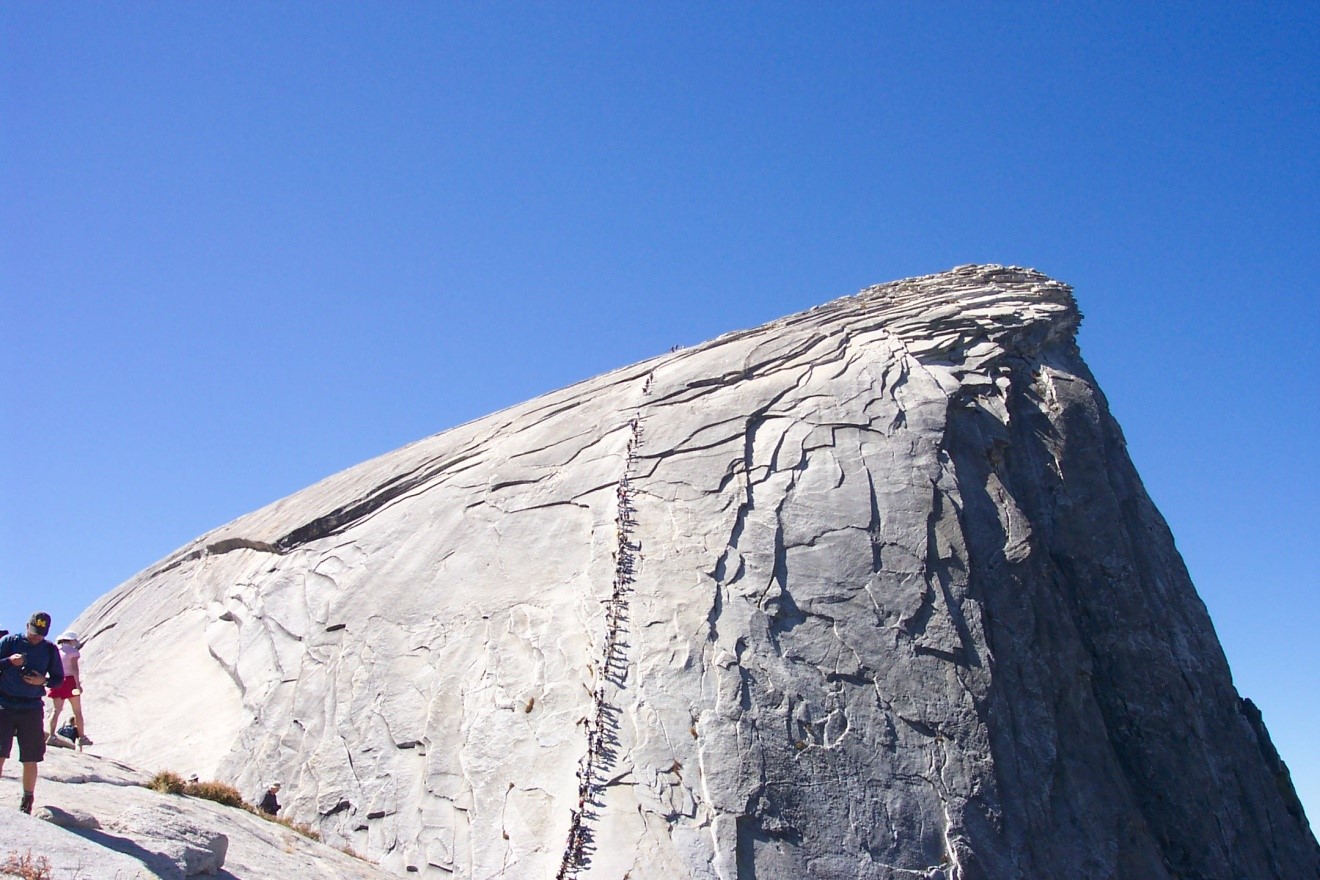
My knee continues to be a source of great pain as we reach the cables. At about 55 degrees, the ascent up the side of Half Dome would be impossible without the 800 or so foot span of steel cables to sue as hand grips. A pile of gloves reminds Jason and me to pull ours out of our packs. I believe that each one of the hundred or so people climbing the cables realizes that one false move would surely lead to their death, as the drop-off on either side would prove fatal.
After about 45 minutes of cable-climbing, we reach the top. I head for the edge where I can look down 4,000 feet, nearly a mile, to Yosemite Valley and our starting point. I truly feel as though I have accomplished something by climbing this peak, named for its geometric shape. From the highest point, I look over the edge of a sheer cliff into the valley, a mile below. Even after skydiving, this sends shivers down my spine.

We spend an hour or so at the top, reveling in our accomplishment and then begin the trip back. Coming down the cables is far more frightening than going up them, but we eventually make it. My need progressively gets worse until I decide to tie a ripped t-shirt around it. Jason fashions a walking stick for me along the way, but by the time we reach my truck, I can barely move my leg. I look back up and have no doubt that the pain only makes the experience mean that much more. In total, we hiked 18 miles with an elevation gain of 4,800 feet. This hike is not for the faint of heart, but has reminded me that willpower can overcome any obstacle.
My friend and fellow adventurer, Jason and I set our sights on Yosemite. We had both visited the National Park before, but were determined to conquer it on this campaign.
Before setting up our camp, we took a short hike through the Mariposa Grove of Giant Sequoias. Although I have seen the behemoths before in the Calaveras Grove, they never seem to disappoint. The magnitude of these specimens is comparable, but the grove has a unique feel to it.
Many trees catch our attention such as the Fallen Monarch, the Bachelor and Three Graces, which posses the placement of a certain famous painting based upon mythology of the Trojan War, and the California Tunnel Tree, which has been cut in such a way as to allow the trail to pass through its trunk. The patriarch of this grove, however, is the Grizzly Giant. Like something from Tolkien’s mythical Lothlorien, this tree rises from a semi-charred area to cast its giant shadow on the ground below. At a height of about 80 feet up, a large branch splits off from the trunk. This branch, however, has a diameter of nearly seven feet; larger than many giant redwoods . . . surreal!
After our short hike, we return to the Wawona Campsite to set up the tent and prepare dinner. While Jason collects some firewood, I prepare some skewers for our bratwurst. A good campfire is one of those precious memories that we cherish for a lifetime, and this is one of those. The crackling embers, the smoky taste to our meal, the incredibly warmth emanating from the flame all add to the experience.
Later that night, I venture out of the tent into a nearby clearing. A glance skyward reveals a majestic view of the stars, unparalleled in my travels. Their number appears to be endless, as if infinity has been demonstrated. After gazing for a short while longer, I return to the tent and enjoy a peaceful rest.
My friends Matt and Rachel have been trying for years to get me down to Rachel’s family’s beach house. And this year, all of the pieces seemed to fall into place. I decided to take some vacation time and join them there over Labor Day week.
Once I arrived, I could not have been more sorry for not visiting this place sooner. Gulf Shores is a tropical paradise. The house, which I stayed at, ahs an unobstructed view of the white, sandy beach, which it sits no more than a hundred yards away from. The bluish-green waves roll in carrying a warm breeze from the Gulf of Mexico.
Lounging here on the beach is one of the most relaxing experiences of my life. I feel at peace here as I pick up a handful of the plentiful sand and watch as it slowly slips through my fingers. Unlike my experiences in Houston, where the water was brown and murky, the ocean here is very clear and amazingly warm. The gentle sound of the waves crashing into the shore only adds to the serenity I feel in this place.
I’ve always thought of the Las Vegas strip as the locale of the greatest Saturday night public parties. That is until I stepped foot on Bourbon Street for the first time. The only relevant analogy I can think of would be that of a parade of army ants marching to restock the nest’s cupboards. However, the human traffic on this small street in the French Quarter of New Orleans is not marching towards food, but marching to the next place that catches their attention with the promise of a good time.
The street itself is no more than a two-lane street with relatively wide sidewalks. The main area of the constant festival of Bourbon Street is concentrated in one area approximately 8 blocks long, but tends to spill out over onto the cross streets and even the streets running parallel to Bourbon, within the Quarter. This entire area, meaning practically every street, is like something frozen in time. Many buildings are two or three hundred years old and remain original in their outward appearance by city ordinance. Unlike the majority of the shop’s original businesses, nearly all have been converted into eateries, taverns, novelty shops, or clubs.
The French Quarter beats to the rhythm of its own distinct drum. The mix of cultures here is quite startling. From the Voodoo culture of Haiti and Jamaica to remnants of culture from the French courts in Paris, this place is alive.
Food, like every other aspect of this combined culture has elements of each parent culture, but has over time, developed into the harmony of Cajun and Creole cuisines. I have tried dishes like fried alligator, steamed crab claws, beef brisket, Jamaican jerk chicken, Cajun seafood gumbo to name a few. All have a distinctive flavoring and are infused with part of the love that people have for food.
As I have read a number of Ann Rice’s Vampire Chronicles over the years, I was a bit excited to have the opportunity to participate in a “vampire tour” through the French Quarter. Much of her interest and inspiration for her books came from local legends, which are told by the very knowledgeable tour guides as the group looks on at the houses where some of these strange, unexplained murders took place. While the guides do not try to sway your belief in vampires one way or the other, they simply end the tour by telling of how their own beliefs have become a little more open-minded since researching the rich and speculatively-supernatural history of this great city.