My friend and fellow adventurer, Jason and I set our sights on Yosemite. We had both visited the National Park before, but were determined to conquer it on this campaign.
Before setting up our camp, we took a short hike through the Mariposa Grove of Giant Sequoias. Although I have seen the behemoths before in the Calaveras Grove, they never seem to disappoint. The magnitude of these specimens is comparable, but the grove has a unique feel to it.
Many trees catch our attention such as the Fallen Monarch, the Bachelor and Three Graces, which posses the placement of a certain famous painting based upon mythology of the Trojan War, and the California Tunnel Tree, which has been cut in such a way as to allow the trail to pass through its trunk. The patriarch of this grove, however, is the Grizzly Giant. Like something from Tolkien’s mythical Lothlorien, this tree rises from a semi-charred area to cast its giant shadow on the ground below. At a height of about 80 feet up, a large branch splits off from the trunk. This branch, however, has a diameter of nearly seven feet; larger than many giant redwoods . . . surreal!
After our short hike, we return to the Wawona Campsite to set up the tent and prepare dinner. While Jason collects some firewood, I prepare some skewers for our bratwurst. A good campfire is one of those precious memories that we cherish for a lifetime, and this is one of those. The crackling embers, the smoky taste to our meal, the incredibly warmth emanating from the flame all add to the experience.
Later that night, I venture out of the tent into a nearby clearing. A glance skyward reveals a majestic view of the stars, unparalleled in my travels. Their number appears to be endless, as if infinity has been demonstrated. After gazing for a short while longer, I return to the tent and enjoy a peaceful rest.
Normal guy with a normal life tries to get out and see the world every chance he gets.
Friday, September 24, 2004
Friday, September 10, 2004
The Beach at Gulf Shores (Baldwin County, Alabama)
My friends Matt and Rachel have been trying for years to get me down to Rachel’s family’s beach house. And this year, all of the pieces seemed to fall into place. I decided to take some vacation time and join them there over Labor Day week.
Once I arrived, I could not have been more sorry for not visiting this place sooner. Gulf Shores is a tropical paradise. The house, which I stayed at, ahs an unobstructed view of the white, sandy beach, which it sits no more than a hundred yards away from. The bluish-green waves roll in carrying a warm breeze from the Gulf of Mexico.
Lounging here on the beach is one of the most relaxing experiences of my life. I feel at peace here as I pick up a handful of the plentiful sand and watch as it slowly slips through my fingers. Unlike my experiences in Houston, where the water was brown and murky, the ocean here is very clear and amazingly warm. The gentle sound of the waves crashing into the shore only adds to the serenity I feel in this place.
Once I arrived, I could not have been more sorry for not visiting this place sooner. Gulf Shores is a tropical paradise. The house, which I stayed at, ahs an unobstructed view of the white, sandy beach, which it sits no more than a hundred yards away from. The bluish-green waves roll in carrying a warm breeze from the Gulf of Mexico.
Lounging here on the beach is one of the most relaxing experiences of my life. I feel at peace here as I pick up a handful of the plentiful sand and watch as it slowly slips through my fingers. Unlike my experiences in Houston, where the water was brown and murky, the ocean here is very clear and amazingly warm. The gentle sound of the waves crashing into the shore only adds to the serenity I feel in this place.
Saturday, September 4, 2004
Bourbon Street (Orleans Parish, Louisiana)
I’ve always thought of the Las Vegas strip as the locale of the greatest Saturday night public parties. That is until I stepped foot on Bourbon Street for the first time. The only relevant analogy I can think of would be that of a parade of army ants marching to restock the nest’s cupboards. However, the human traffic on this small street in the French Quarter of New Orleans is not marching towards food, but marching to the next place that catches their attention with the promise of a good time.
The street itself is no more than a two-lane street with relatively wide sidewalks. The main area of the constant festival of Bourbon Street is concentrated in one area approximately 8 blocks long, but tends to spill out over onto the cross streets and even the streets running parallel to Bourbon, within the Quarter. This entire area, meaning practically every street, is like something frozen in time. Many buildings are two or three hundred years old and remain original in their outward appearance by city ordinance. Unlike the majority of the shop’s original businesses, nearly all have been converted into eateries, taverns, novelty shops, or clubs.
The French Quarter beats to the rhythm of its own distinct drum. The mix of cultures here is quite startling. From the Voodoo culture of Haiti and Jamaica to remnants of culture from the French courts in Paris, this place is alive.
Food, like every other aspect of this combined culture has elements of each parent culture, but has over time, developed into the harmony of Cajun and Creole cuisines. I have tried dishes like fried alligator, steamed crab claws, beef brisket, Jamaican jerk chicken, Cajun seafood gumbo to name a few. All have a distinctive flavoring and are infused with part of the love that people have for food.
As I have read a number of Ann Rice’s Vampire Chronicles over the years, I was a bit excited to have the opportunity to participate in a “vampire tour” through the French Quarter. Much of her interest and inspiration for her books came from local legends, which are told by the very knowledgeable tour guides as the group looks on at the houses where some of these strange, unexplained murders took place. While the guides do not try to sway your belief in vampires one way or the other, they simply end the tour by telling of how their own beliefs have become a little more open-minded since researching the rich and speculatively-supernatural history of this great city.
The street itself is no more than a two-lane street with relatively wide sidewalks. The main area of the constant festival of Bourbon Street is concentrated in one area approximately 8 blocks long, but tends to spill out over onto the cross streets and even the streets running parallel to Bourbon, within the Quarter. This entire area, meaning practically every street, is like something frozen in time. Many buildings are two or three hundred years old and remain original in their outward appearance by city ordinance. Unlike the majority of the shop’s original businesses, nearly all have been converted into eateries, taverns, novelty shops, or clubs.
The French Quarter beats to the rhythm of its own distinct drum. The mix of cultures here is quite startling. From the Voodoo culture of Haiti and Jamaica to remnants of culture from the French courts in Paris, this place is alive.
Food, like every other aspect of this combined culture has elements of each parent culture, but has over time, developed into the harmony of Cajun and Creole cuisines. I have tried dishes like fried alligator, steamed crab claws, beef brisket, Jamaican jerk chicken, Cajun seafood gumbo to name a few. All have a distinctive flavoring and are infused with part of the love that people have for food.
As I have read a number of Ann Rice’s Vampire Chronicles over the years, I was a bit excited to have the opportunity to participate in a “vampire tour” through the French Quarter. Much of her interest and inspiration for her books came from local legends, which are told by the very knowledgeable tour guides as the group looks on at the houses where some of these strange, unexplained murders took place. While the guides do not try to sway your belief in vampires one way or the other, they simply end the tour by telling of how their own beliefs have become a little more open-minded since researching the rich and speculatively-supernatural history of this great city.
Sunday, August 29, 2004
Lover's Leap (El Dorado, California)
As I write these words, I am sitting on the summit of a shear granite face, known as Lover’s Leap; quite an obvious name for a point such as this. Leaning over the rock I’m sitting on, the objects in the valley below, some 700 ft down appear as ants on the pavement. This area provides breathtaking views of the American River Valley and a bird’s eye view of the charming little hamlet of Strawberry.
I can certainly see why the local signs speak of a rock climber’s paradise. While I took a relatively easy trail to get here, I felt a bit squeamish as I ventured along the crumbling granite overhangs. The steepness of these faces would be enough to induce a heart attack in those so prone. Add to that, the sudden gusts of wind, which suddenly seem to be at home up here and I too feel the need to constantly double-check my footing.
One can’t help but feel a bit divine up here. Looking down on the lowlands, must be something like looking down from Heaven.
Thursday, August 19, 2004
Lagomarsno Canyon Petroglyphs (Storey County, Nevada)
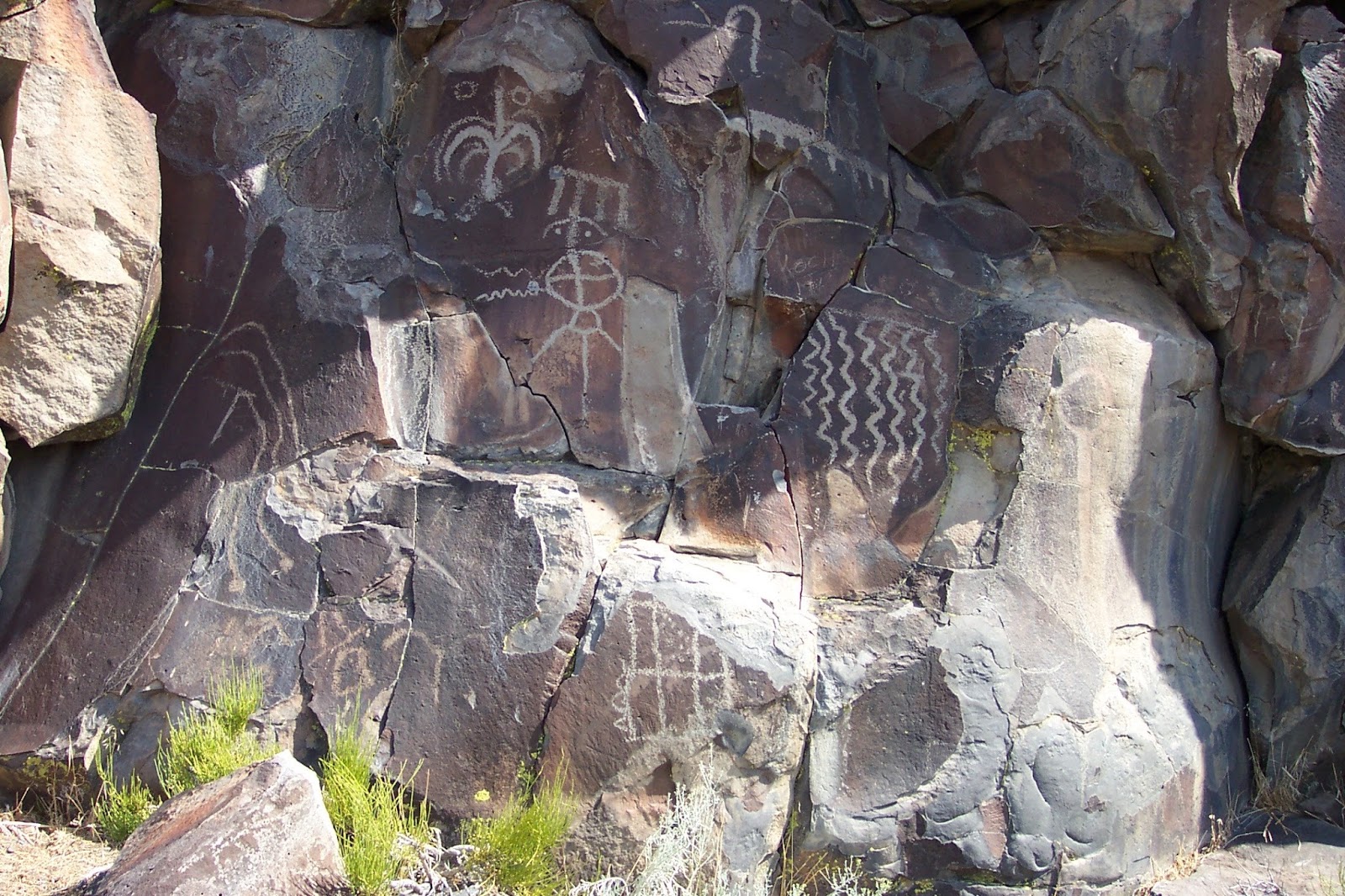
When I first heard of the existence of prehistoric rock art so close to my home, I instantly wanted to visit and see this small window into the past. Lagomarsino Canyon is about thirty miles East of Reno and about twelve miles North-East of Virginia City, but that is not to say it is easy to get to. Some of the roughest roads I have ever encountered must be traversed to reach this canyon. Only through my friend Jason’s skilled driving and his fiancĂ©e’s 4X4 were we able to reach this location.
While there are a number of stone walls scattered along the hills here, the petroglyphs themselves are scratched into the large basalt boulders of a cliff on the North side of the canyon. From what I am told this short, but jagged cliff was used by Native Americans to run game to their deaths. It seems perfect for that purpose.
According to a sign at the base of the cliff, many of the primitive motifs appear to be 4,000-5,000 years old, but some may be as old as 10,000 years. There are many recurring themes: wavy lines, geometric patterns, and wild life. By doing some very basic rock climbing, we are able to see nearly one hundred images.
As with anything of this nature, the explorer cannot help but ask some basic questions: Why were these drawn? By who? And what were the artists like? Perhaps, they were drawn by mere children, trying to express themselves or perhaps, by a group of men who had not yet found their place in the world and were simply trying to tell future generations that they had existed. We may never know for sure, but I suspect their purpose for creating such marks in time may not be much different than our own.
While there are a number of stone walls scattered along the hills here, the petroglyphs themselves are scratched into the large basalt boulders of a cliff on the North side of the canyon. From what I am told this short, but jagged cliff was used by Native Americans to run game to their deaths. It seems perfect for that purpose.
According to a sign at the base of the cliff, many of the primitive motifs appear to be 4,000-5,000 years old, but some may be as old as 10,000 years. There are many recurring themes: wavy lines, geometric patterns, and wild life. By doing some very basic rock climbing, we are able to see nearly one hundred images.
As with anything of this nature, the explorer cannot help but ask some basic questions: Why were these drawn? By who? And what were the artists like? Perhaps, they were drawn by mere children, trying to express themselves or perhaps, by a group of men who had not yet found their place in the world and were simply trying to tell future generations that they had existed. We may never know for sure, but I suspect their purpose for creating such marks in time may not be much different than our own.
Saturday, June 19, 2004
Black Rock Desert (Washoe County, Nevada)
This trip had nothing to do with hiking and everything to do with an exercise in freedom. The Black Rock Desert is a strip of completely flat, completely lifeless land North of Gerlach, NV. It is approximately 120 miles long running north to south and 15 miles wide. This area is the site of the pagan summer festival known as “Burning Man” and was the location of the most recent land speed record run.
I find a launch point and drive out onto the white, sandy playa. I’ve been told that driving on the surface when it is wet is a sure way to be the talk of the office after having your truck airlifted out of the muck. Understandably, I proceed with caution. I’m amazed at how comfortable my truck seems on this terrain. I accelerate to 40; to 50. I accelerate still more to 60; now more . . . 70 . . . 80! Eighty miles an hour with no road in site and no rhyme or reason to the path I’m driving. I veer, I swerve, no need to worry about obstacles here. This must be what space is like.
To continue that analogy, I notice that there is absolutely no echo when I speak, after stopping to take a few photos. I pack the camera, and proceed to start looking for a way back onto the road. This is only the first stop of a long weekend.
Wednesday, June 16, 2004
Kayaking from Sand Harbor (Washoe County, Nevada)
Sand Harbor, on the Northwest Shore of Lake Tahoe is an idealistic destination for a novice kayaker, such as myself. The Sandy beach, which acts as a terrific launch point is covered by white granite grains, a bit larger than white sea sand, but with a comfortable texture to walk on nonetheless. So alien does this white beach appear in this alpine setting with snow-capped mountains in the distance, that I had to ask my companions, Jason and Craig, if it had been man made or if it was natural. Natural they both replied with a proud smile.
The famed water of the Caribbean cannot possibly be any bluer or any more clear than the cold waters of Lake Tahoe. After launching, but still within the boulder-filled harbor, I am amazed to be able to see the lake bottom at a depth of fifty to seventy-five feet. If not for the frigidness of the water, I would be tempted to dive in and practice my non-existent scuba skills.
Pathways through the large granite boulders provide an amateur obstacle course for practicing my maneuvering techniques. I manage my way through with few collisions and we continue down the shoreline.
At about half-a-mile, we encounter the antiquated Thunderbird Lodge, a holdover from days past and a popular site of local weddings. The grounds are practically littered with small boathouses and servant’s quarters, all surrounding the main stone structure. When this served as a private residence many years ago, how lucky the inhabitants must have been to awaken to this view of the lake.
We continue on darting away from and toward the shoreline in alternating coves for some more obstacle course practice. I stop to take a couple of shots with my trusty camera, after fiddling with my spray skirt and the waterproof box that contains my valuables.
Around the next point, we reach Chimney Beach, so names for the lone remnant of the former structure placed on this sandy shore and boxed in by vehicle-sized pieces of granite. The local wildlife and remaining tenants of this home-that-was, a group of six or seven chipmunk-lie creatures, come out to beg for some of our nutritious snacks. As I comment about the tameness of these chipmunks, which are now within inches of us, I am corrected and informed that the little miscreants are actually a small shore-tailed form of squirrel. We clean up our trash and that of some former visitors and begin to make the long trek back to our launch point.
The waves here are not only as blue as the sky, but seem to contain no smaller ripples within, as jiggling gelatin in a desert dish.
In total, we paddled approximately three miles and my arms are somewhat sore, but what a marvelous day. This must be the most beautiful lake on the face of the Earth.
The famed water of the Caribbean cannot possibly be any bluer or any more clear than the cold waters of Lake Tahoe. After launching, but still within the boulder-filled harbor, I am amazed to be able to see the lake bottom at a depth of fifty to seventy-five feet. If not for the frigidness of the water, I would be tempted to dive in and practice my non-existent scuba skills.
Pathways through the large granite boulders provide an amateur obstacle course for practicing my maneuvering techniques. I manage my way through with few collisions and we continue down the shoreline.
At about half-a-mile, we encounter the antiquated Thunderbird Lodge, a holdover from days past and a popular site of local weddings. The grounds are practically littered with small boathouses and servant’s quarters, all surrounding the main stone structure. When this served as a private residence many years ago, how lucky the inhabitants must have been to awaken to this view of the lake.
We continue on darting away from and toward the shoreline in alternating coves for some more obstacle course practice. I stop to take a couple of shots with my trusty camera, after fiddling with my spray skirt and the waterproof box that contains my valuables.
Around the next point, we reach Chimney Beach, so names for the lone remnant of the former structure placed on this sandy shore and boxed in by vehicle-sized pieces of granite. The local wildlife and remaining tenants of this home-that-was, a group of six or seven chipmunk-lie creatures, come out to beg for some of our nutritious snacks. As I comment about the tameness of these chipmunks, which are now within inches of us, I am corrected and informed that the little miscreants are actually a small shore-tailed form of squirrel. We clean up our trash and that of some former visitors and begin to make the long trek back to our launch point.
The waves here are not only as blue as the sky, but seem to contain no smaller ripples within, as jiggling gelatin in a desert dish.
In total, we paddled approximately three miles and my arms are somewhat sore, but what a marvelous day. This must be the most beautiful lake on the face of the Earth.
Subscribe to:
Posts (Atom)